
Why is PEEK the ideal material for interbody fusion cage
The spine is human mast, supporting the weight of the whole body. With the advent of the information age, great changes have taken place in people’s production and life style. More and more people need to sit at their desk for a long time. With the aggravation of the aging of society, spine-related diseases, such as cervical spondylosis, lumbar disc herniation, lumbar spinal stenosis, lumbar spondylolisthesis and scoliosis, have become common and frequently occurring diseases that affect the quality of life of the masses. Therefore, spinal diseases are a hot topic of common concern in society.
In the current medical field, interbody fusion surgery is a common spinal surgical treatment for various spinal problems, such as intervertebral disc degeneration, spinal deformity, spinal injury and other related conditions. Intervertebral fusion in the original intervertebral disc into a fixed Cage (intervertebral fusion), through the Cage support, restore intervertebral height, expand the intervertebral foramen, relieve nerve compression symptoms, to improve the stability of the segment, avoid subsequent degenerative diseases adjacent segment.
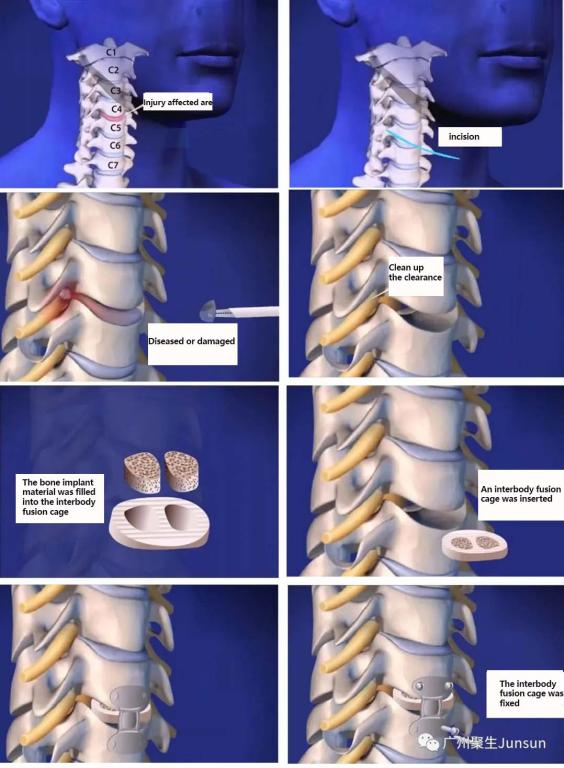
Figure I: Anterior cervical discectomy and fusion with an interbody fusion cage
Intervertebral fusion process
To use the intervertebral fusion intervertebral disc resection arthrodesis anterior portion of the road, for example, by surgical removal of the cervical vertebra protruding or pathological changes of intervertebral disc, so as to reduce caused by partial disc oppressed nerve root pain of neck pain and upper limb radioactive. The surgeon performs the operation through an incision in the front of the neck. First the surgeon removes the diseased or damaged disc. The upper and lower Spaces of the disc were then cleared in preparation for interbody fusion cage placement. The bone graft material was filled into the interbody fusion cage and pushed into the intervertebral space. Doctors later screw will plate fixation implants are available, and can guarantee will bone block in spinal heals maintain in office. In the process of healing, intervertebral fusion of vertebra will be connected together to form a new bone block, this process is called “convergence” (Figure 1).
How to choose the material of interbody fusion cage
Materials of interbody fusion cage There are four main types of materials of interbody fusion cage:
①Biological
It mainly refers to allogenic bone. The advantages of this method are that the source is sufficient to ensure the amount of bone graft, which is conducive to the rapid fusion of the intervertebral space. However, it has the risk of disease transmission, and it is difficult to maintain the intact structure to resist the axial load, so it is not ideal for the maintenance of the height and physiological curvature of the intervertebral space.
②Metal
It mainly includes titanium alloy and so on. It has excellent biomechanical properties and good stability in the early stage, which is convenient for 3D printing to prepare personalized interbody fusion cage. It has the disadvantages of high elastic modulus, stress shielding, high risk of cage sinking, occupying effective bone growth space, and it is difficult to determine the internal bone fusion by X-ray examination. There are metal artifacts in CT and MRI examination, and the production of metal debris may cause long-term osteolysis.
③Degradable material
Such as polycarbonate, alpha acid polymer, etc. The advantages are good hydrophilicity and good biocompatibility. However, its inherent fragility makes it easy to fragment during surgery, requires a long time for bone replacement, and high concentrations of degradation products (acids and crystalline components) can lead to severe tissue reactions such as infection and osteolysis, which limits its clinical application.
④High polymer material
Carbon fiber, polyetheretherketone (PEEK) and so on. PEEK is the best selection of intervertebral fusion, partly replaced by titanium, widely accepted by the orthopaedic surgeon. Characteristics of PEEK is close to the bone tissue elastic modulus, mechanical properties close to cortical bone, smaller stress shelter. Good pervious to light, good imaging observation. However, its surface odontoid process is shallow, the bite force is poor, and it is easy to shift. It must be used in combination with strong internal fixation.
The ideal cage material should have the following characteristics:
①Good biocompatibility;
②Stable chemical properties;
③Biomechanical properties similar to bone tissue;
④Promote bone fusio;
⑤Conducive to image observation;
⑥It is degradable .
Classification of interbody fusion cage
There are many design schemes for the profile of the cage.
Think about it in a cross-sectional way
Rectangle and kidney are two popular designs at present, and rectangle fuses are usually used in pairs. The shape of the kidney and the shape of the disc are closer to the contour, which can better share the stress, and it is usually used in a single piece.
Think about it in the sagittal plane
From the sagittal plane, there are two main types of fusion cage: wedge and olive. Wedge shape refers to the shape of high front and low back, which can effectively restore part of the physiological curvature of the lumbar spine after the insertion of the fusion cage, but this shape will also cause greater resistance during the insertion, and the insertion operation is relatively difficult. It is mainly used for patients with intervertebral disc degeneration or lesions. The olive contour is similar to the physiological curvature of the end plate surface, and the insertion operation is easy.
From the perspective of internal space
According to whether the internal design of the intervertebral cage is hollow or not, it is divided into three types: closed intervertebral cage, open intervertebral cage and porous intervertebral cage. The closed interbody fusion cage is generally a solid structure of metal material with or without surface coating. Open interbody fusion cage, which is a common rectangular structure, hollow design, in which granular bone can be placed; Porous interbody fusion cage is usually made of tantalum metal, and its microporosity is as high as 80%. The structure similar to trabecular bone can make the bone fusion rate higher.

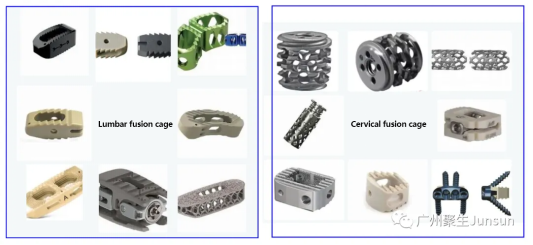
Various shapes of PEEK cage
Ideal interbody fusion cage design
In the era of PEEK material, interbody fusion devices conforming to various surgical methods appear in competition. The competition of various products is basically reflected in the shape of the fusion device, the design of anti-slip spine, and the bone grafting cabin. The promotion point is nothing more than more reasonable caliber, more complete specifications, more in line with the appearance of physiology, more smooth placement, better anti-slip effect, and larger bone grafting area.
The ideal design of interbody fusion cage should meet the following conditions:
①Immediate stability. For example, the surface of the intervertebral fusion device increases the bite force, or the expansion device increases the stability after implantation.
②Long-term stability. The large bone graft cavity capacity inside the intervertebral fusion device and the large contact area of the adjacent vertebral body are conducive to the final fusion.
③Close to the normal physiological curvature of the lumbar spine. It conforms to the anatomical shape of the normal intervertebral space of the human body.
④Adjustable size, easy installation and non-destructive placement path.
For spine surgery, intervertebral fusion of success not only depends on the material of osteogenesis potential, also depends on the material to promote angiogenesis and bone implant fusion ability, thus to promote the integration of bone. Fusion material also plays an additional role in mechanical load distribution by reducing local stresses, such as polyetheretherketone can resist spinal load, thus providing initial stability with a similar elastic modulus to bone to minimize graft settlement. Titanium can be modified to promote bone growth to the surface of the material. However, the current treatment methods, such as arc ion plating technology, cannot achieve the exact effect of close bonding of the PEEK-titanium interface coating, which may cause potential risks such as local inflammation caused by coating exfoliation.
Although there are numerous reports in the current literature on implant materials and design, there are limited reports on how interbody fusion cage selection affects clinical outcomes. At present, most research focuses on animal experiments, and new technologies and materials are expected to be continuously developed and gradually applied to clinical practice to make up for the shortcomings of existing technologies or materials.
Guangzhou Junsun medical technology co., LTD., independent research and development, the production level of medical implant polyether ether ketone (PEEK) material performance, low price, complete size is suitable for all kinds of intervertebral fusion cage.