
PEEK or UHMWPE: Which is Better for Medical Implants
In the field of medical grade implants, polyetheretherketone(PEEK) and ultra-high-molecular-weight polyethylene (UHMWPE) are two of the most widely used polymers. Both offer excellent biocompatibility but differ significantly in mechanical properties, clinical applications, and long-term performance.
This article provides a detailed comparison, covering:
Material properties
Clinical applications
Advantages & limitations
Future trends
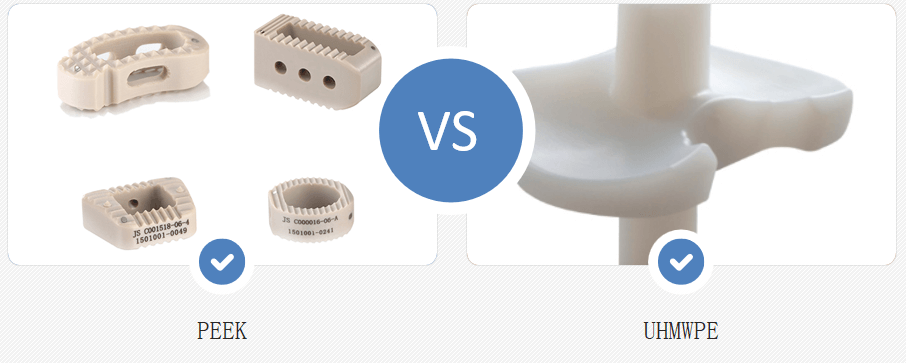
1. Material Properties Comparison
| Property | Medical PEEK | Medical UHMWPE |
| Chemical Structure | Aromatic, semi-crystalline | Linear polyethylene (MW >1 million) |
| Density (g/cm³) | 1.3–1.45 | 0.93–0.94 (lighter) |
| Melting Point (°C) | 343 | 130–136 |
| Elastic Modulus (GPa) | 3–4 (close to cortical bone) | 0.5–1.2 (close to cartilage) |
| Tensile Strength (MPa) | 90–100 | 30–40 |
| Wear Resistance | Good (for load-bearing) | Excellent (best for joints) |
| Biocompatibility | ISO 10993 certified | ISO 10993 certified |
Key Takeaways:
PEEK is stiffer and better for structural support.
UHMWPE is softer and excels in wear resistance.
2. Clinical Applications
PEEK’s Primary Uses
Spinal implants: Interbody fusion cages (reduces stress shielding).
Trauma fixation: Craniofacial plates, screws (radiolucent).
Dental: Abutments, prosthetics (chemically inert).
Radiotherapy: Custom shields (radiation-resistant).
UHMWPE’s Dominant Roles
Joint replacements: Hip/knee liners (low friction, wear-resistant).
Sports medicine: Meniscus implants (shock-absorbing).
Historical use: Heart valve sewing rings (now rare).
Why the Difference?
PEEK’s bone-like stiffness makes it ideal for fusion devices.
UHMWPE’s superior wear resistance suits articulating surfaces.
3. Performance Pros & Cons
| Factor | PEEK Advantages | UHMWPE Advantages |
| Mechanical Strength | High rigidity for load-bearing | High toughness for impact absorption |
| Imaging Compatibility | MRI-safe, X-ray translucent | MRI-safe but X-ray opaque |
| Longevity | No degradation (permanent implants) | Potential microparticle wear |
| Processing | Requires high-temp molding (>300°C) | Low-pressure sintering (<200°C) |
Critical Considerations:
PEEK is preferred where imaging visibility and mechanical stability matter.
UHMWPE dominates in high-wear, low-stress environments.
4. Technological Advancements
PEEK Innovations
3D-printed porous structures (enhanced osseointegration).
Carbon-fiber reinforcement (modulus up to 18 GPa).
HA coatings (improved bone bonding).
UHMWPE Breakthroughs
Cross-linked UHMWPE (XLPE): 90% less wear than conventional PE.
Vitamin-E doping: Prevents oxidative degradation.
Composite blends: Carbon fiber/UHMWPE for strength.
5. Market Leaders & Products
| Aspect | PEEK Examples | UHMWPE Examples |
| Global Brands | Invibio PEEK-OPTIMA® | Zimmer Biomet ArComXL® |
| Chinese Brands | Junsun Medical NATUREGEN® PEEK | Shandong Weigao UHMWPE liners |
| Implants | Stryker Tritanium® spinal cage | DePuy Synthes Marathon® hip cup |
6. Future Outlook
PEEK’s Next Frontier
Resorbable PEEK (eliminates removal surgery).
Smart implants (drug-eluting, antibacterial).
UHMWPE’s Evolution
Self-lubricating composites (e.g., hydrogel-infused).
Antimicrobial coatings (silver nanoparticles).
Coexistence Strategy
PEEK for structural implants (spine, dental).
UHMWPE for joint interfaces (hips, knees).
Conclusion
While PEEK and UHMWPE serve different medical needs,
both are irreplaceable in modern implantology. The choice depends on:
Mechanical demands (load-bearing vs. articulation).
Imaging requirements (X-ray/MRI compatibility).
Long-term performance (wear vs. stability).
For surgeons & manufacturers:
PEEK is the gold standard for fusion devices.
UHMWPE remains unbeatable for joint replacements.