
How Are Fusion Cages Used in Human Bones?
1. Function, Materials, and Selection of Fusion Cages
Interbody fusion cages are critical implants in spinal surgery, used to stabilize vertebral bodies, restore disc height, and promote bone fusion. Their primary functions include:
- Maintaining Disc Height: Preventing post-operative disc collapse and reducing nerve compression.
- Providing Stability: Ensuring mechanical stability during the fusion process.
- Promoting Bone Fusion: The cage can be filled with bone graft materials (e.g., autograft, allograft, or synthetic bone) to accelerate intervertebral fusion.
Common Materials and Selection Criteria
The most widely used fusion cage materials are:
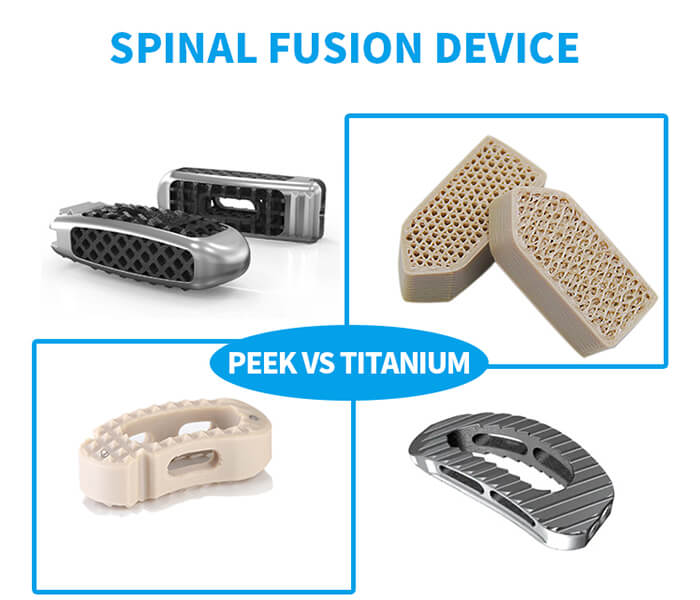
- Titanium: High strength and excellent biocompatibility, but may cause imaging artifacts (e.g., in CT/MRI).
- PEEK (Polyetheretherketone): Elastic modulus similar to bone, reducing stress shielding, and radiolucent for better post-operative imaging.
- Composite Materials: Such as carbon fiber-reinforced PEEK or 3D-printed porous titanium, combining the advantages of metals and polymers.
- Selection Guidelines:
- Cervical Surgery: PEEK or titanium is preferred for balancing stability and imaging clarity.
- Lumbar Surgery: High-load regions (e.g., L4-L5, L5-S1) may favor titanium or composites, while OLIF/TLIF often use PEEK.

2. Applications of Different Fusion Cage Designs
Fusion cages vary in shape depending on surgical approach and anatomical location. Common types include:
1. Cervical Spinal Fusion Cage
Shape: Rectangular or wedge-shaped, some with serrated surfaces for better fixation.
Application: Primarily used in Anterior Cervical Discectomy and Fusion (ACDF) for cervical disc herniation or degenerative diseases.
2. TLIF Cage (Transforaminal Lumbar Interbody Fusion)
Shape: Curved or banana-shaped for easier transforaminal insertion.
Application: Used in TLIF surgery for lumbar spondylolisthesis or degenerative disc disease.
3. PLIF Cage (Posterior Lumbar Interbody Fusion)
Shape: Larger, typically rectangular or wedge-shaped.
Application: Used in PLIF surgery, requiring more nerve retraction, suitable for severe lumbar instability.
4. OLIF Cage (Oblique Lumbar Interbody Fusion)
Shape: Wide footprint to cover more endplate area.
Application: Used in OLIF surgery, avoiding major nerves and muscles, ideal for degenerative scoliosis or spinal stenosis.
3. Key Advantages and Current Applications of PEEK Fusion Cages
PEEK fusion cages have become a mainstream choice in spinal surgery due to their superior properties:
- Key Advantages:
Elastic modulus close to bone, reducing stress shielding and adjacent segment degeneration.
Radiolucent, allowing clear post-operative CT/MRI evaluation.
Excellent biocompatibility with no long-term toxicity.
- Current Applications:
Widely used in cervical and lumbar surgeries, especially minimally invasive procedures (e.g., MIS-TLIF, OLIF).
Some PEEK cages incorporate titanium coatings or 3D printing to enhance bone integration.
4. Major PEEK Fusion Cage Brands and Manufacturers (Domestic & International)
International Brands
- Medtronic– CAPSTONE® PEEK Cervical Cage
- Stryker– AVS™ PEEK Lumbar Cage
- Johnson & Johnson– CONDUIT™ PEEK Cage
- NuVasive– PEEK CoRoent® Series
Domestic Brands (China)
- WEGO– PEEK Spinal Fusion Cages
- MicroPort– EZspan® PEEK Cage
- Chunli Medical– 3D-Printed PEEK Cages
- Dabo Medical– PEEK Spinal Implants
Conclusion
Fusion cages play a vital role in spinal surgery, with diverse designs catering to various clinical needs. PEEK cages, with their excellent mechanical properties and imaging compatibility, have become a leading choice. Both international and domestic manufacturers offer high-quality PEEK fusion cages. With advancements in 3D printing and composite materials, fusion cage technology will continue to evolve, improving outcomes for patients with spinal disorders.